Adventure Story Generator
Create thrilling adventure stories powered by AI. From treacherous expeditions and treasure hunts to survival tales and daring escapades, our adventure story generator crafts action-packed narratives that take you to the edge of the unknown.
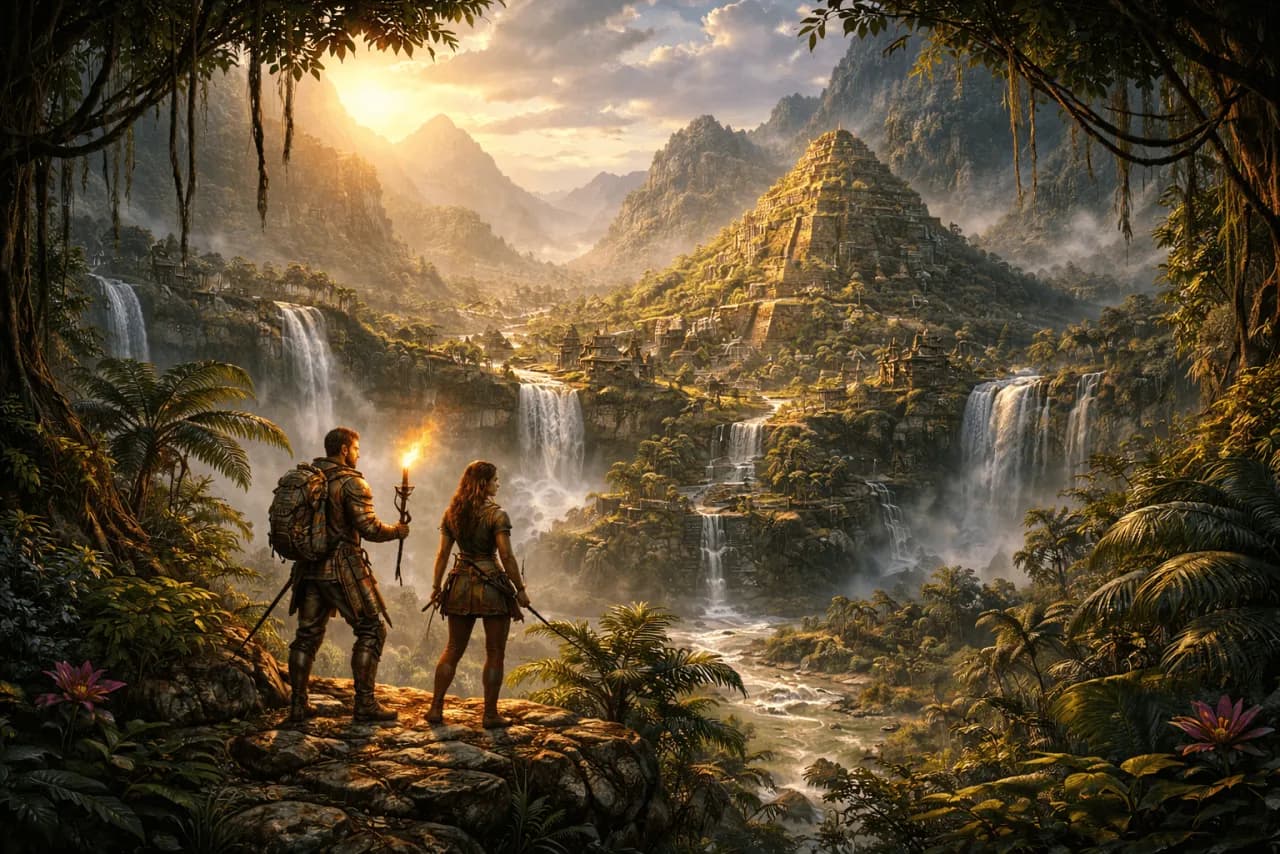
What is Adventure Fiction?
Adventure fiction is a genre defined by excitement, risk, and the thrill of exploration. From the seafaring tales of Robert Louis Stevenson to the globe-trotting adventures of Clive Cussler, adventure stories have captivated readers for centuries. The genre's timeless appeal lies in its ability to transport readers to exotic locations, pit ordinary people against extraordinary challenges, and celebrate the human spirit's courage and resourcefulness in the face of danger.
Key Elements of Adventure Stories
The Journey
A physical journey to unknown or dangerous places: uncharted islands, dense jungles, ancient ruins, or hostile territories.
High Stakes
Life-or-death situations, races against time, and consequences that keep the tension high from start to finish.
Resourceful Heroes
Protagonists who rely on courage, quick thinking, and determination to overcome obstacles and survive impossible odds.
Exotic Settings
Vivid, immersive locations that become characters in their own right, from scorching deserts to frozen peaks.
Discovery
Hidden treasures, lost civilizations, secret passages, and revelations that reward the hero's perseverance.
Ninety Metres
Generated from the prompt “An expedition must cross a dangerous obstacle with equipment they no longer trust”
The rope bridge was ninety metres across and had been built by people who were all now dead of old age.
"It held for the porters in March," Esi said.
"The porters in March weighed less than we do and it has rained every day since," said Tomas. He was already unpacking the rope they had carried for four hundred kilometres precisely so they would not have to use this bridge, and precisely so that carrying it would turn out to have been a waste, which was the outcome he had wanted.
There was not enough of it. They both knew there was not enough of it. He unpacked it anyway, because measuring it again was a way of not looking at the gorge.
"Sixty," he said eventually.
"Sixty."
"We could go back to the confluence and try the northern route."
"That is eleven days," Esi said, "and we have six days of food, and you have known both of those numbers since Thursday."
Tomas coiled the rope. He did it slowly and neatly, the way he did everything when he was frightened, and Esi let him, because in eleven years she had learned that rushing him produced nothing but a badly coiled rope and a worse argument.
"I'll go first," he said.
"You're heavier."
"Yes," he said. "That's the point. If it holds for me it holds for you, and if it doesn't, you're still on this side with the food."
Esi discovered she had no counter-argument, which was different from agreeing.
He went out onto the bridge. At the eleventh plank something gave with a sound like a knuckle cracking, and he stopped, and did not look down, and after a moment kept going.
Why this one works
Adventure is often written as spectacle, but the tension here comes from arithmetic. Sixty metres of rope, ninety metres of gorge, eleven days back, six days of food. The reader can do the sums, which means the danger is understood rather than merely asserted. The best line is the one about Tomas unpacking rope he knows is too short. It tells us he is frightened, that he needs to be seen doing something, and that his hope is irrational, all without naming any of it. Esi letting him coil the rope slowly does the same job for their relationship: eleven years compressed into one act of restraint. Note the ending. No triumph, no fall, just a sound like a knuckle cracking and a man deciding to continue. Adventure stories are frequently ruined by resolving the danger. Stopping mid-crossing keeps the gorge open.
How to Write Adventure Stories
Make the obstacle specific and measurable
Vague peril generates no tension. Concrete numbers, distances, supplies and deadlines let the reader calculate the risk themselves, which is far more involving than being told something is dangerous.
Andy Weir's The Martian runs almost entirely on this. Calories, sols and litres of water create suspense because the reader can follow the maths and see the margin shrinking.
Let the journey change the traveller
A character who arrives the same as they departed has taken a trip rather than an adventure. The external route and the internal shift should be the same movement.
In Homer's Odyssey the return home is the plot, but the story is about what a decade of trying to get there does to the man doing it.
Use competence to build trust, then take it away
Showing characters who are genuinely good at something earns reader confidence. Removing the tool, the map or the expert is far more frightening once that competence has been established.
Adventure fiction from Jack London onward relies on this. A character who knows exactly how to build a fire is in real trouble when the conditions defeat the technique.
Give the group a reason to fracture
External danger alone flattens a party into a single unit. Differing goals, unequal risk and old history produce the friction that makes an expedition feel human.
The pressure in most survival narratives comes from disagreement about the route rather than from the terrain itself.
Common Adventure Mistakes
Danger without consequence
If every peril is escaped without cost, the reader stops believing in the next one. Something has to be spent: supplies, trust, a limb, a person.
Weaker
The avalanche swept past them, missing the camp by metres. Shaken but unharmed, they packed up and continued.
Stronger
The avalanche took the eastern cache. Nobody was hurt, which they said to each other several times that evening, as though the food had not been in it.
Travelogue instead of story
Long sequences of terrain and weather read as itinerary. Every stretch of journey needs a decision, a disagreement or a cost attached to it.
Weaker
They walked for three days through the valley, then crossed the ridge and descended into the forest, where they camped for the night.
Stronger
By the third day in the valley they had stopped discussing the ridge, which was how Esi knew Tomas had already decided they were not going over it.
A protagonist with no meaningful limitation
A character equal to every challenge removes the question of whether they will succeed. Limits are what make competence interesting.
Weaker
Kalu was an expert climber, tracker, navigator and diver, and had never yet met terrain he could not handle.
Stronger
Kalu could climb anything. What he could not do was swim, which had never mattered until the map showed the crossing.
Adventure Books Worth Reading
The Martian
by Andy WeirSurvival adventure built from problem-solving, and a model for making technical detail generate suspense rather than slow it.
Treasure Island
by Robert Louis StevensonThe template for the genre, and still unmatched for pacing and for an antagonist as charming as Long John Silver.
The Call of the Wild
by Jack LondonEnvironment as antagonist, written with a hard clarity that resists sentimentality.
Into Thin Air
by Jon KrakauerNon-fiction, but essential reading for how group dynamics fail under pressure and how disasters accumulate from small decisions.
The Hobbit
by J.R.R. TolkienA journey structured as a sequence of escalating episodes, each one changing the traveller a little more.
Kon-Tiki
by Thor HeyerdahlA first-hand account of a genuinely reckless voyage, useful for the texture of daily life on an expedition.
Adventure Writing Questions
What separates adventure from action?
Action is about immediate physical conflict, usually resolved within a scene. Adventure is about a journey with a goal, where the scale is larger and the danger accumulates over distance and time. An action story can happen in one building; an adventure generally needs somewhere to go.
Does an adventure story need a physical journey?
Usually, though the journey can be modest. What the genre requires is movement into unfamiliar territory and a goal worth the risk. That territory can be a mountain range, a city the character has never entered, or a stretch of water a mile wide.
How do I keep a long journey from becoming repetitive?
Vary what each stage demands. If one section tests endurance, make the next test judgement, then trust, then supplies. Attach a decision or a disagreement to each leg so the reader is following choices rather than distance.
How much research does adventure writing need?
Enough that the practical details do not ring false, since readers who know the activity will notice immediately. You do not need expertise, but you should know roughly how long things take, what equipment weighs, and what actually goes wrong.
How can an AI story generator help with adventure writing?
It is good for generating obstacles, complications and setbacks when you need the journey to keep turning. Ask for several ways a crossing could go wrong, then choose the one that costs your characters something they cannot easily replace.
Adventure Story Prompts to Try
Featured Stories
Read adventure and other stories written here and shared by the people who made them, each published with the prompt that produced it.
Ready for an adventure? Try our adventure story generator and create an epic journey in seconds.
Start Writing a Adventure Story →