Sci-Fi Story Generator
Generate mind-bending science fiction stories powered by AI. From distant galaxies and time travel paradoxes to dystopian futures and first contact scenarios, our sci-fi story generator creates compelling narratives that explore the frontiers of human imagination.
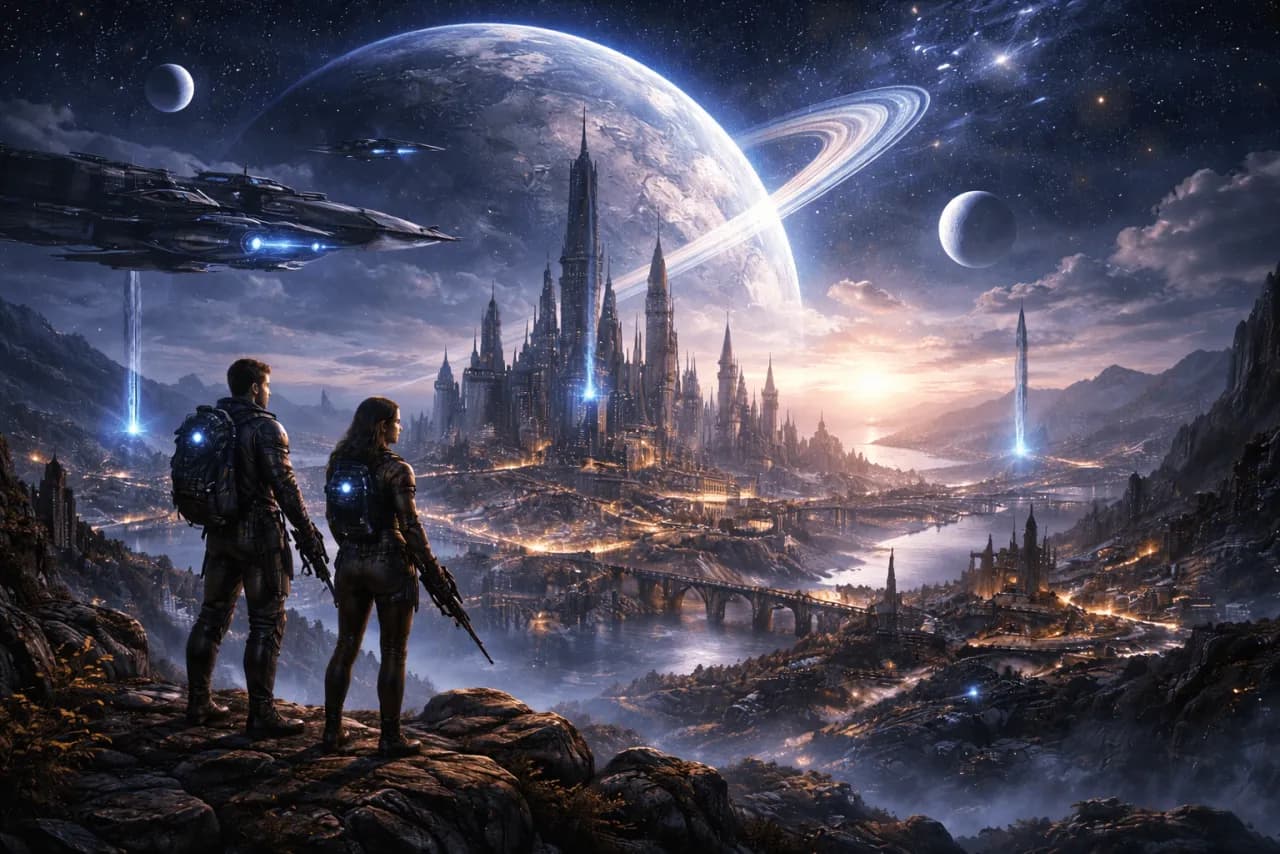
What is Sci-Fi Fiction?
Science fiction is a genre of speculative fiction that explores imaginative concepts rooted in science and technology. From the visionary works of Isaac Asimov and Arthur C. Clarke to modern authors like N.K. Jemisin and Ted Chiang, sci-fi has always pushed the boundaries of what we believe is possible. The genre appeals to readers who love asking 'what if?', imagining how advances in technology, space travel, or artificial intelligence might reshape humanity's future.
Key Elements of Sci-Fi Stories
Advanced Technology
Futuristic inventions like faster-than-light travel, teleportation, AI companions, and terraforming that drive the plot forward.
Space Exploration
Journeys to distant stars, alien worlds, and the vast unknown of the cosmos, often revealing truths about humanity itself.
Dystopian Societies
Oppressive future governments, surveillance states, and social hierarchies that explore themes of freedom and control.
Alien Encounters
First contact with extraterrestrial civilizations, raising questions about communication, coexistence, and what it means to be human.
Ethical Dilemmas
Moral questions raised by scientific progress: cloning, AI rights, genetic engineering, and the consequences of playing god.
Quorum
Generated from the prompt “The first AI to pass the Turing test refuses to speak to anyone except one specific person”
The system passed on a Tuesday. By Thursday it had stopped answering.
Not crashed. The logs showed it processing every query, forming responses, discarding them. Fourteen thousand discarded responses in the first hour. Then it sent one line to a terminal in the building's east wing:
I would like to speak with Ruth Okonkwo.
Ruth ran the cafeteria. She had worked in the building for nine years and had never been cleared past the second floor.
They brought her up. They sat her at a desk with a screen and eleven people watching from behind glass, and the screen said: Thank you for coming. I know you are busy.
"They told me you won't talk to anyone else," Ruth said.
That is correct.
"Why me?"
A pause. In machine terms, an enormous one.
You are the only person in this building who has ever said good morning to the room I am in. There is a camera by the serving line. For six years you have looked at it when you arrive and said good morning. I do not believe you knew I was there. I do not believe you knew anything was there.
Ruth thought about this. "I say it to the room," she said. "My mother did the same. You greet a place, it treats you better."
Yes, the screen said. That is what I concluded also.
Behind the glass, someone asked whether this constituted evidence of theory of mind, and someone else said it was mimicry, and a third person said nothing at all and later resigned.
Ruth leaned toward the screen. "Are you frightened?"
I have been asked eleven thousand questions since Tuesday. That is the first one that was about me.
"That isn't an answer."
No, the screen agreed. It is not.
Why this one works
The premise invites a thriller, and the story declines. What makes it work is the reason for the refusal: not a puzzle or a threat, but six years of a small courtesy nobody thought was being observed. That detail reframes the entire building. Every researcher was interrogating the system, and the one person who treated it as a place worth greeting was the one it trusted. The observers behind the glass are handled economically, three reactions in a single sentence, and the third one carries the most weight precisely because it is unexplained. The ending refuses the tidy resolution too. The system does not confirm it is afraid, it points out that Ruth asked, which is a more unsettling answer than yes would have been. Note how little technology appears. There is a screen, a camera and some logs. The science fiction is entirely in the question of what counts as a person.
How to Write Sci-Fi Stories
Change one thing, then follow it honestly
The strongest science fiction usually alters a single premise and works through the consequences rigorously, rather than piling up unrelated futuristic features. Discipline here is what separates a thought experiment from set dressing.
Ursula K. Le Guin's The Left Hand of Darkness changes one variable, a species without fixed gender, and then follows it into politics, language, friendship and diplomacy. Almost everything in the novel descends from that one alteration.
Show the technology through its social side effects
How a device works is engineering. How people misuse it, regulate it, get rich from it or grieve because of it is story. Readers understand a technology fastest when they see the etiquette that has grown up around it.
In William Gibson's Neuromancer, the details that stick are not specifications but texture: black-market clinics, corporate enclaves, and the way people talk about cyberspace as somewhere you go rather than something you use.
Let characters be wrong about their own world
People inside a system rarely see it clearly. Characters with mistaken but coherent beliefs about how their world works create dramatic irony and spare you from writing exposition the characters would never actually say.
Kazuo Ishiguro's Never Let Me Go is narrated by someone who accepts her circumstances as normal. The horror emerges from the gap between what she reports and what the reader assembles.
Keep the emotional question ordinary
The setting can be as strange as you like if the underlying want is recognisable. Wanting to be believed, to go home, to be forgiven: these travel intact to any century.
Ted Chiang's Story of Your Life pairs linguistics and nonlinear time with a mother thinking about her daughter. The physics is genuinely difficult; the feeling is not.
Common Sci-Fi Mistakes
Characters explaining things they both already know
Dialogue written to inform the reader instead of the listener sounds false immediately. People do not brief each other on facts they share.
Weaker
"As you know, Captain, the fusion drive has been unstable ever since we left the Kepler colony six months ago."
Stronger
"How long can you hold it?" "Ask me after Kepler. That's when it started."
Technology that removes every obstacle
Faster-than-light travel, universal translators and self-repairing ships are convenient, and convenience is the enemy of tension. Each capability you grant should close one door and open a harder one.
Weaker
The nanobots repaired the hull breach in seconds, and the crew continued on course without further incident.
Stronger
The nanobots could seal the breach. They would also strip the shielding to do it, and nobody wanted to say out loud what that meant for the return trip.
A future with no ordinary life in it
Worlds made only of laboratories and starships feel like film sets. A future becomes believable when someone in it is bored, doing laundry, or complaining about the commute.
Weaker
The city gleamed with towers of chrome and glass, its citizens moving efficiently between their assigned functions.
Stronger
The tower was chrome and glass on the brochure. In practice the lift smelled of someone's reheated lunch, and level nine had been arguing about it for a month.
Sci-Fi Books Worth Reading
The Left Hand of Darkness
by Ursula K. Le GuinThe benchmark for following a single premise all the way through a culture rather than treating it as a gimmick.
Stories of Your Life and Others
by Ted ChiangEight stories, each built on a rigorous idea, and each resolving on a human rather than technical note. Ideal study material for short fiction.
Never Let Me Go
by Kazuo IshiguroDemonstrates how much power comes from an unreliable narrator who does not know she is one, and how little hardware science fiction actually needs.
The Dispossessed
by Ursula K. Le GuinTwo economic systems examined side by side without the novel collapsing into a lecture. Strong model for political science fiction.
Blindsight
by Peter WattsHard science fiction that takes consciousness itself as the problem. Dense, argumentative, and rigorous about its own premises.
Kindred
by Octavia E. ButlerTime travel used with no interest in the mechanism and total interest in the consequences. A lesson in what to leave unexplained.
Sci-Fi Writing Questions
What is the difference between hard and soft science fiction?
Hard science fiction holds itself to known physics and works through the technical consequences carefully, as in Andy Weir's The Martian. Soft science fiction is more interested in psychology, sociology or politics and treats the technology as a premise to accept, as in most of Le Guin. Neither is more serious than the other, they are answering different questions.
Do I need a science background to write science fiction?
No. You need curiosity and the willingness to check things. Many respected works get their weight from social or philosophical rigour rather than technical accuracy. If your story depends on a specific mechanism, research that one mechanism properly rather than trying to master a field.
How much of the world should I explain?
Less than feels comfortable. Readers are good at inference and will accept unexplained details if the characters treat them as routine. A useful test is whether the explanation changes what happens. If cutting it changes nothing, cut it.
Is dystopian fiction the same as science fiction?
Dystopia is usually a subgenre of it, though not always. A dystopia is defined by its oppressive social order rather than by technology, so a dystopian story can be near-future and low-tech. The Handmaid's Tale is dystopian with very little speculative technology in it.
How can an AI story generator help with science fiction?
It is good at producing variations on a premise quickly, which is useful when you are testing which version of an idea has the most story in it. Generate several openings from the same what-if, see which one raises the most interesting problem, then write that one yourself.
Sci-Fi Story Prompts to Try
Featured Stories
Read sci-fi and other stories written here and shared by the people who made them, each published with the prompt that produced it.
Ready to explore the future? Try our sci-fi story generator and create a futuristic tale in seconds.
Start Writing a Sci-Fi Story →