Fantasy Story Generator
Create epic fantasy stories with the power of AI. Whether you dream of sprawling magical kingdoms, brave heroes on impossible quests, or ancient prophecies waiting to be fulfilled, our fantasy story generator brings your imagination to life in seconds.
What is Fantasy Fiction?
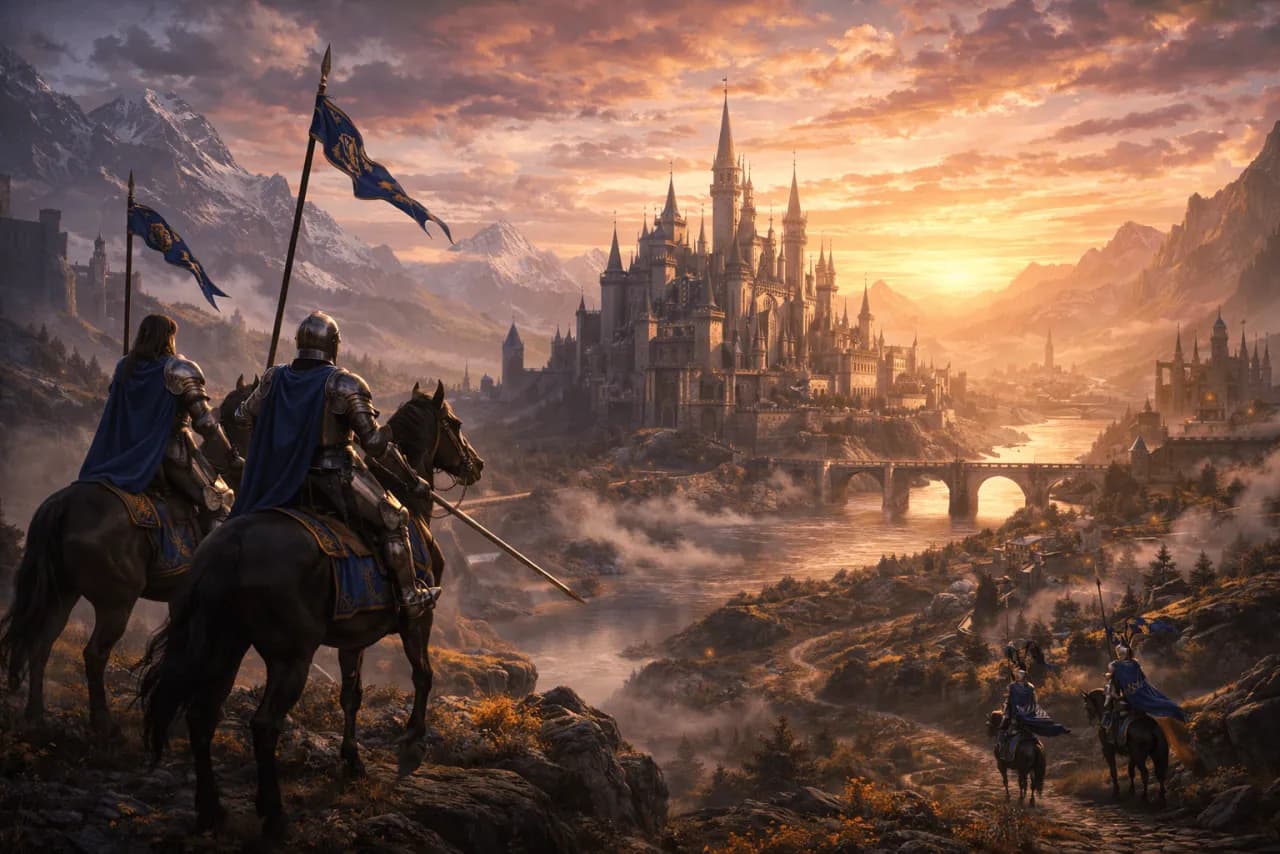
Fantasy fiction is a genre built on imaginative worlds where magic, mythical creatures, and supernatural forces are real. Rooted in ancient mythology and folklore, fantasy has evolved from the epic works of J.R.R. Tolkien and C.S. Lewis into one of the most beloved genres in literature. Its appeal lies in the sense of wonder and escapism it offers. Readers are transported to worlds where anything is possible, and ordinary people can become legendary heroes.
Key Elements of Fantasy Stories
Magic Systems
Rules and structures that govern how magic works in the world, from elemental spells to ancient runes and enchantments.
Mythical Creatures
Dragons, elves, dwarves, unicorns, and other fantastical beings that inhabit the world and shape its history.
Epic Quests
Heroes embarking on grand journeys to defeat evil, recover lost artifacts, or fulfill ancient prophecies.
World-Building
Richly detailed settings with their own geography, cultures, languages, and political systems.
Good vs. Evil
A central conflict between forces of light and darkness, often with the fate of the entire world at stake.
The Cartographer's Mistake
Generated from the prompt “A mapmaker discovers that the maps they draw become real places that people can enter”
Maren had drawn the coastline wrong on purpose. It was a small vanity, a cove tucked between two headlands where no cove existed, shaped like a sleeping cat because she had been thinking of her sister's cat when her hand moved.
The commission was for a merchant house, and merchants did not check coastlines against the sea. They checked them against other maps. So the cove spread. It appeared in a harbour chart, then in a customs ledger, then in the sailing orders of a grain ship whose captain had never been that far north.
She learned this eleven months later, when a woman came to her shop and set a jar of salt water on the counter.
"From Cat's Cove," the woman said. "You'll want to see it. There are forty of us living there now. We built a chapel."
Maren looked at the jar. The water was ordinary. It caught the light the way any water catches light.
"That place is not real," she said.
"It has a chapel," the woman repeated, as though this settled the matter, and Maren understood that it did.
She took the commission for the northern survey that spring. She told herself she was going to correct the error. She packed her good pens, the ones with the fine nibs, and a bottle of ink dark enough to swallow a shoreline.
Standing on the headland six weeks later, watching smoke rise from forty chimneys that she had invented in an idle moment, Maren found she could not uncap the ink. Below her, a bell rang for evening prayers in a chapel built by people who had trusted a line she drew without thinking.
She went down the path to the village. She had, after all, drawn the path too, and it would have been rude not to use it.
Why this one works
This example works because the magic has a cost that arrives late and lands on the person responsible. The premise could have gone in an obvious direction, with the mapmaker gaining power and drawing herself a palace. Instead the story treats the invented cove as an ordinary bureaucratic accident that propagates through harbour charts and customs ledgers, which makes the fantastical element feel procedural rather than whimsical. The detail that seals it is the chapel. A chapel means people arrived, stayed, and organised their lives around a place that began as a doodle of a sleeping cat. The closing line does the emotional work without stating it: Maren cannot erase the cove because erasing it would kill forty people, so she walks down her own invented path and joins them. Notice also how little world-building the story does. There is no magic system, no explanation of why her maps work. The story trusts that the reader cares about the consequence rather than the mechanism.
How to Write Fantasy Stories
Give magic a price, not just a rule
Readers stop worrying about how magic works once they see what it costs. A limit that hurts the character is worth more than a page of explanation, because it turns magic into a source of dilemmas rather than solutions.
In Ursula K. Le Guin's A Wizard of Earthsea, magic works through true names, but the rule that matters is that every act of magic disturbs a balance. Ged's mistake early in the book follows him for the rest of it, which makes his power feel dangerous rather than convenient.
Build the world through what characters take for granted
Descriptions of a world tend to read like an encyclopedia. Characters treating something strange as unremarkable tells the reader far more, because it implies a whole society that has already normalised it.
Terry Pratchett does this constantly on the Discworld. Nobody stops to explain that the world rides on a turtle. The characters worry about tax, guild politics and whether the post is running, and the reader assembles the world from those complaints.
Anchor the epic in something small
The fate of a kingdom is an abstraction. A specific person losing a specific thing is not. Attach the large stakes to something the reader can hold in their head, and the large stakes start to matter.
The Lord of the Rings runs on this. The war is enormous, but the emotional weight sits on whether Sam can carry Frodo up a hill, and on the Shire the hobbits are trying to get back to.
Let the setting resist the hero
A world that only provides obstacles the hero can overcome feels like scenery. A world with its own logic, indifferent to what the protagonist needs, feels inhabited.
In N.K. Jemisin's The Fifth Season, the continent itself is hostile and the social order around orogenes is designed to control them. The setting is not a backdrop to the conflict, it is the conflict.
Common Fantasy Mistakes
Front-loading the world-building
Opening with the history of the realm asks the reader to memorise names before they have any reason to care about them. Curiosity has to come first, and curiosity comes from people.
Weaker
The kingdom of Eldrath had been founded three thousand years earlier by the seven High Lords, who divided the land into provinces after the War of Ash. Each province was governed by a Warden, and the Wardens answered to the Throne of Glass in the capital city of Vantimor.
Stronger
The tax collector had come from Vantimor, which meant Eldrath had remembered the village existed. Nobody in the village considered this good news.
Magic that solves the problem it created
If a spell can undo the difficulty, the difficulty was never real. Tension needs the reader to believe the cost will actually be paid.
Weaker
The bridge collapsed into the gorge. Fortunately, Aldric remembered the levitation incantation his master had taught him, and lifted the entire company safely to the far side.
Stronger
The bridge collapsed into the gorge. Aldric knew a levitation incantation. He also knew it worked on one person at a time, and there were nine of them, and the pass would be dark in an hour.
Prophecy as a substitute for motivation
A character who acts because a prophecy says so has no agency. The reader is watching a schedule play out rather than a decision get made.
Weaker
The prophecy foretold that the orphan would take up the sword and defeat the Dark Lord, so Kira took up the sword and set out for the citadel.
Stronger
Kira did not believe the prophecy. She believed her brother was inside the citadel, and that the sword was the only thing in the village worth stealing.
Fantasy Books Worth Reading
A Wizard of Earthsea
by Ursula K. Le GuinThe clearest demonstration in the genre of magic with a moral cost, told in prose spare enough to study line by line.
The Fifth Season
by N.K. JemisinShows how structure itself can carry meaning, with three timelines that reframe each other, and a world where geology is the antagonist.
The Hobbit
by J.R.R. TolkienWorth reading for pacing. It moves from a comfortable kitchen to a dragon's hoard without ever losing the thread of one reluctant character.
Sabriel
by Garth NixA tightly ruled magic system, where necromancy has procedures and bells, and the rules generate the plot rather than decorate it.
Uprooted
by Naomi NovikDraws on Polish folklore rather than the usual medieval European template, and treats the forest as a genuinely alien intelligence.
Small Gods
by Terry PratchettComic fantasy that carries real philosophical weight, and a masterclass in world-building through offhand detail.
Fantasy Writing Questions
What makes a story fantasy rather than science fiction?
The usual dividing line is how the impossible is explained. Fantasy grounds it in magic, myth or forces that operate outside natural law, while science fiction grounds it in technology or scientific extrapolation, however speculative. The line blurs often. Star Wars has knights, prophecies and a mystical energy field, which puts it closer to fantasy than its spaceships suggest.
Do I need to build an entire world before I start writing?
No, and doing so is a common way to never start. You need enough to write the first scene convincingly, which is usually one location, one rule about how magic behaves, and one thing your character wants. Build outward from the story as questions come up, rather than trying to answer them all in advance.
How detailed should a magic system be?
Detailed enough that readers can predict its limits, which is what lets them feel tension. Brandon Sanderson's rule of thumb is useful here: your ability to resolve conflict with magic is proportional to how well the reader understands it. If magic solves problems, explain it. If magic mostly creates atmosphere and problems, mystery serves you better.
Is fantasy only about medieval European settings?
Not at all, though the genre leaned that way for decades. Some of the strongest recent fantasy draws on West African, South Asian, Slavic and Mesoamerican traditions, or invents settings with no historical analogue. The medieval castle is a convention, not a requirement.
How can an AI story generator help with fantasy writing?
It is most useful for generating raw material quickly: a first draft to react against, several variations on a premise, or a character sketch you can rewrite in your own voice. Treat the output as a starting point rather than a finished piece. The specific, strange details that make fantasy memorable usually come from you rather than the model.
Fantasy Story Prompts to Try
Featured Stories
Read fantasy and other stories written here and shared by the people who made them, each published with the prompt that produced it.
Ready to craft your own fantasy epic? Try our fantasy story generator and create a magical tale in seconds.
Start Writing a Fantasy Story →